
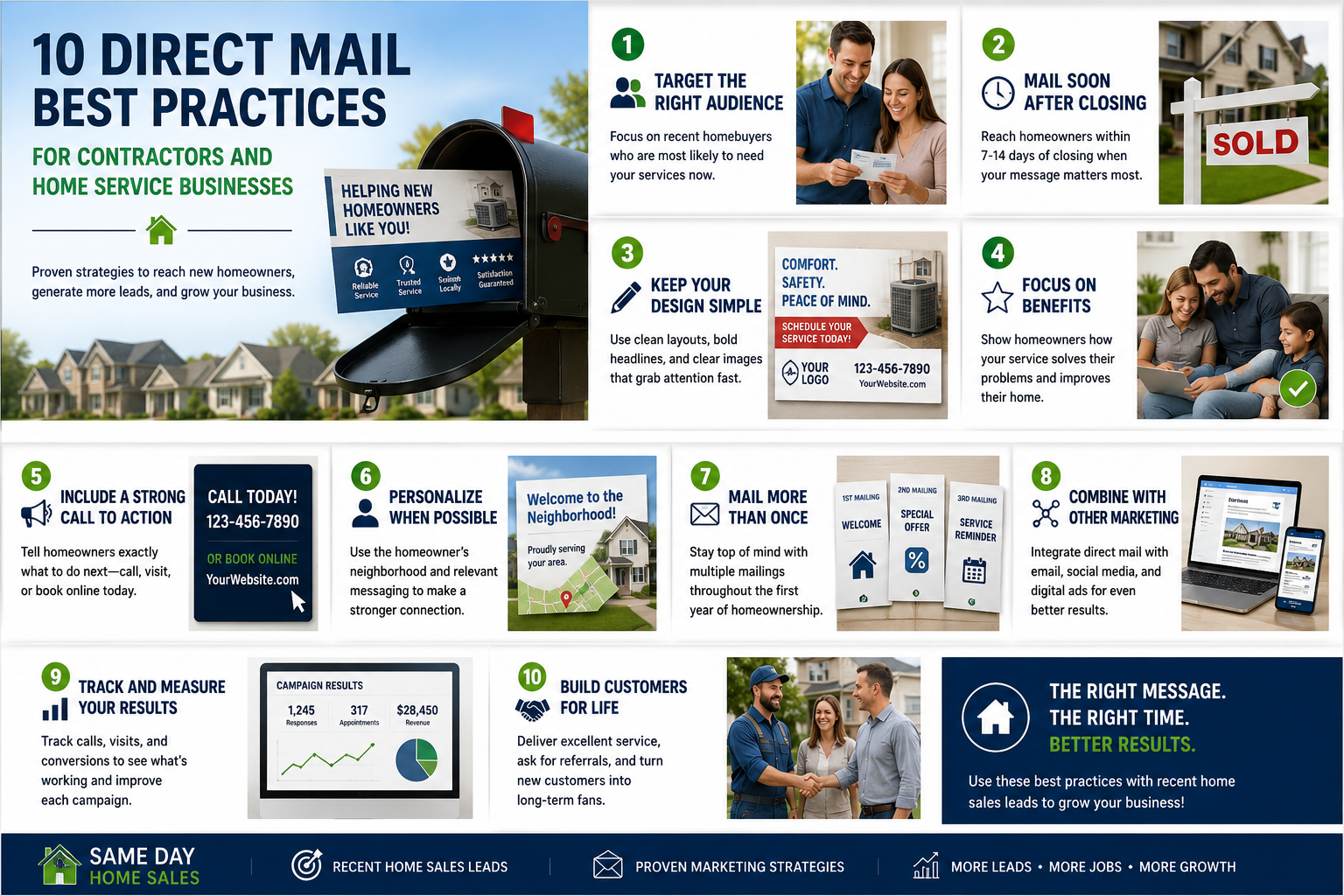
Direct Mail Best Practices for Contractors
A successful direct mail campaign involves more than purchasing a mailing list and sending postcards.
Effective campaigns combine a relevant audience, a clear message, professional design, timely delivery, and consistent follow-up.
For contractors and home service businesses, direct mail can be especially useful when it reaches homeowners at a point when repairs, maintenance, upgrades, or other home-related decisions may still be ahead.
By following the best practices in this guide, you can build a more organized direct-mail strategy, make your message easier for homeowners to understand, and better measure the results of your marketing.
Start With the Right Audience
Even a well-designed postcard may produce disappointing results if it is sent to people who have little connection to your services.
That is one reason recent homebuyers can be a useful audience for contractors and home service businesses.
After purchasing a property, homeowners may begin making decisions about maintenance, repairs, upgrades, landscaping, remodeling, and other home services.
Rather than advertising only to a broad group of homeowners, recent home sales marketing allows you to focus your direct-mail efforts on people who have recently purchased a home.
Recent Home Sales Leads provide the new homeowner’s name and property address, helping you make a timely introduction through direct mail.
Mail Soon After Homeowner Information Becomes Available
Timing can play an important role in direct-mail marketing.
Some homeowners may begin planning repairs, maintenance, improvements, or other projects shortly after purchasing a home, while others may not need your services until later.
Because Same Day Home Sales homeowner information is updated daily, contractors can begin their direct-mail outreach soon after newly available home sales information is identified.
A mailing schedule might include:
- An initial introduction soon after homeowner information becomes available
- Additional follow-up during the first few months
- Seasonal mailings when appropriate for your services
- Future reminders for maintenance, upgrades, or related services
Early outreach gives your business an opportunity to begin building recognition while many home-related decisions may still be ahead.
Learn more about reaching New Homeowners.
Keep Your Design Simple
One common direct-mail mistake is trying to fit too much information onto a single postcard.
Homeowners should be able to understand your main message quickly.
A postcard may include:
- A clear headline
- One primary message
- High-quality photography or graphics
- Your company logo
- Phone number
- Website
- A clear call to action
Avoid excessive text, competing messages, and too many graphics that make the postcard difficult to scan.
The goal is to make it easy for homeowners to understand who you are, what you offer, and what they should do next.
Focus on Benefits Instead of Only Features
Homeowners generally want to understand how your service can help solve a problem, maintain their property, or improve their home.
Instead of focusing only on company features, connect those features to a homeowner benefit.
Instead of:
“We’ve been in business for 20 years.”
Consider:
“Keep your new home comfortable year-round with professional HVAC maintenance.”
Instead of:
“We offer pest control.”
Consider:
“Protect your new home from ants, spiders, and other common household pests.”
Your company history, experience, certifications, and services can still be important, but the message should also explain why those things matter to the homeowner.
Include a Clear Call to Action
Do not make homeowners guess what to do next.
A clear call to action tells them how to learn more or contact your business.
Examples include:
- Schedule Your Free Estimate
- Call Today
- Book Online
- Request a Quote
- Visit Our Website
- Claim Your New Homeowner Offer
A clear call to action can make the next step easier for homeowners and gives your campaign a specific response to measure.
Make Your Message Relevant
Relevant messaging can help a direct-mail piece feel more connected to the homeowner receiving it.
Examples may include:
- Mentioning the homeowner’s neighborhood
- Welcoming them to their new home
- Using localized messaging
- Including seasonal recommendations
- Featuring nearby projects
- Sharing a relevant customer testimonial
- Highlighting services that may be useful to recent homeowners
The goal is not simply to personalize the postcard. It is to make the message more useful and relevant to the audience you are contacting.
Consider More Than One Mailing
One postcard may introduce your company, but additional mailings can help reinforce your name and services over time.
A simple campaign might look like this:
Initial Mailing
Welcome the homeowner and introduce your company.
One Month Later
Share a helpful tip, educational message, or relevant offer.
Three Months Later
Send a seasonal maintenance reminder or highlight another service.
Six Months Later
Feature a completed project, customer testimonial, or additional service.
Nine Months Later
Remind homeowners about services they may need later in the year.
Twelve Months Later
Send a homeownership anniversary message, maintenance reminder, or relevant offer.
The exact schedule should depend on your services, market, budget, and customer response.
Consistent communication can help reinforce familiarity without relying on a single mailing to produce an immediate response.
Coordinate Direct Mail With Other Marketing
Direct mail can work as one part of a broader marketing strategy.
For example, a homeowner might:
Receive your postcard
↓
Visit your website
↓
Search for your company on Google
↓
Read your reviews
↓
Request an estimate
↓
Voluntarily provide an email address for future communication
Your website, Google Business Profile, local search presence, reviews, social media, and other marketing can support the introduction made through direct mail.
After a homeowner voluntarily provides an email address and permission to receive communications, Email Marketing can help you continue the relationship with educational content, seasonal reminders, and relevant offers.
Neighborhood Marketing can also help build recognition in the areas where your company already works.
Track Every Campaign
Tracking your results can help you understand which direct-mail strategies are creating the strongest opportunities.
Useful measurements may include:
- Calls received
- Website visits
- QR code scans
- Contact form submissions
- Estimate requests
- Coupon or offer redemptions
- Appointments scheduled
- Projects sold
- Revenue generated
After each campaign, consider questions such as:
- Which postcard generated the most responses?
- Which offer received the most interest?
- Which neighborhoods produced the strongest results?
- Which services generated the most inquiries?
- What was the cost per new customer?
- How much revenue was associated with the campaign?
Reviewing these results over time can help you improve future campaigns and make more informed marketing decisions.
Our Marketing ROI guide explains how to evaluate marketing costs and results.
Think Beyond the First Project
The value of a new customer does not always end with the first completed project.
A satisfied homeowner may return for:
- Maintenance services
- Annual inspections
- Seasonal services
- Equipment replacement
- Additional remodeling
- Other home improvements
They may also leave reviews or recommend your business to friends, family members, and neighbors.
That is why it can be useful to look beyond the immediate revenue from a direct-mail campaign and consider the longer-term customer relationship.
Our Customer Lifetime Value page explains how repeat business, referrals, and future projects can contribute to the overall value of a customer.
Direct Mail Success Checklist
Before sending your next campaign, review these basic steps:
✔ Target a relevant audience within your service area.
✔ Use a clean, professional postcard design.
✔ Focus on homeowner benefits rather than only company features.
✔ Include one clear call to action.
✔ Display your phone number and website prominently.
✔ Consider multiple mailings instead of relying on a single postcard.
✔ Support direct mail with your website, local search presence, reviews, and other marketing.
✔ Use email marketing only after homeowners voluntarily provide their email address and permission to receive communications.
✔ Track responses and measure campaign performance.
✔ Continue building relationships after the first project.
Final Thoughts
Effective direct mail does not need to explain every service your company offers in a single postcard.
Its first job is often much simpler: introduce your business, communicate a relevant message, and give homeowners an easy way to learn more.
When combined with Recent Home Sales Leads, direct mail can help contractors make a timely introduction to homeowners who have recently purchased a property.
Your website, reviews, local search presence, neighborhood marketing, and permission-based email communication can then provide additional opportunities for homeowners to learn about your company and stay connected.
By tracking results, improving your campaigns over time, and continuing to provide useful communication after the first contact, direct mail can become part of a broader marketing system designed to build recognition, customer relationships, repeat business, and referrals.
Related Resources
Learn more about using Recent Home Sales Leads to reach newly identified homeowners through direct mail.
Explore New Homeowner Leads for additional information about marketing to people who have recently purchased a home.
Our Email Marketing guide explains how to stay connected after a homeowner voluntarily provides an email address and permission to receive communications.
Use Neighborhood Marketing to build additional recognition in the communities where your company works.
Review Marketing ROI to better understand campaign costs and performance, and Customer Lifetime Value to evaluate the potential value of customer relationships beyond the first project.
A few important improvements I made here: I removed the unsupported “7–14 days after closing” rule, because your data is based on newly available public-record information rather than necessarily giving us the exact moment a homeowner closes. I also replaced claims like “personalized marketing consistently outperforms,” “increases conversion rates,” and “most successful businesses” with more defensible wording.
And I corrected the internal links to the current structure, including New Homeowner Leads, Email Marketing, Neighborhood Marketing, Marketing ROI, and Customer Lifetime Value.